
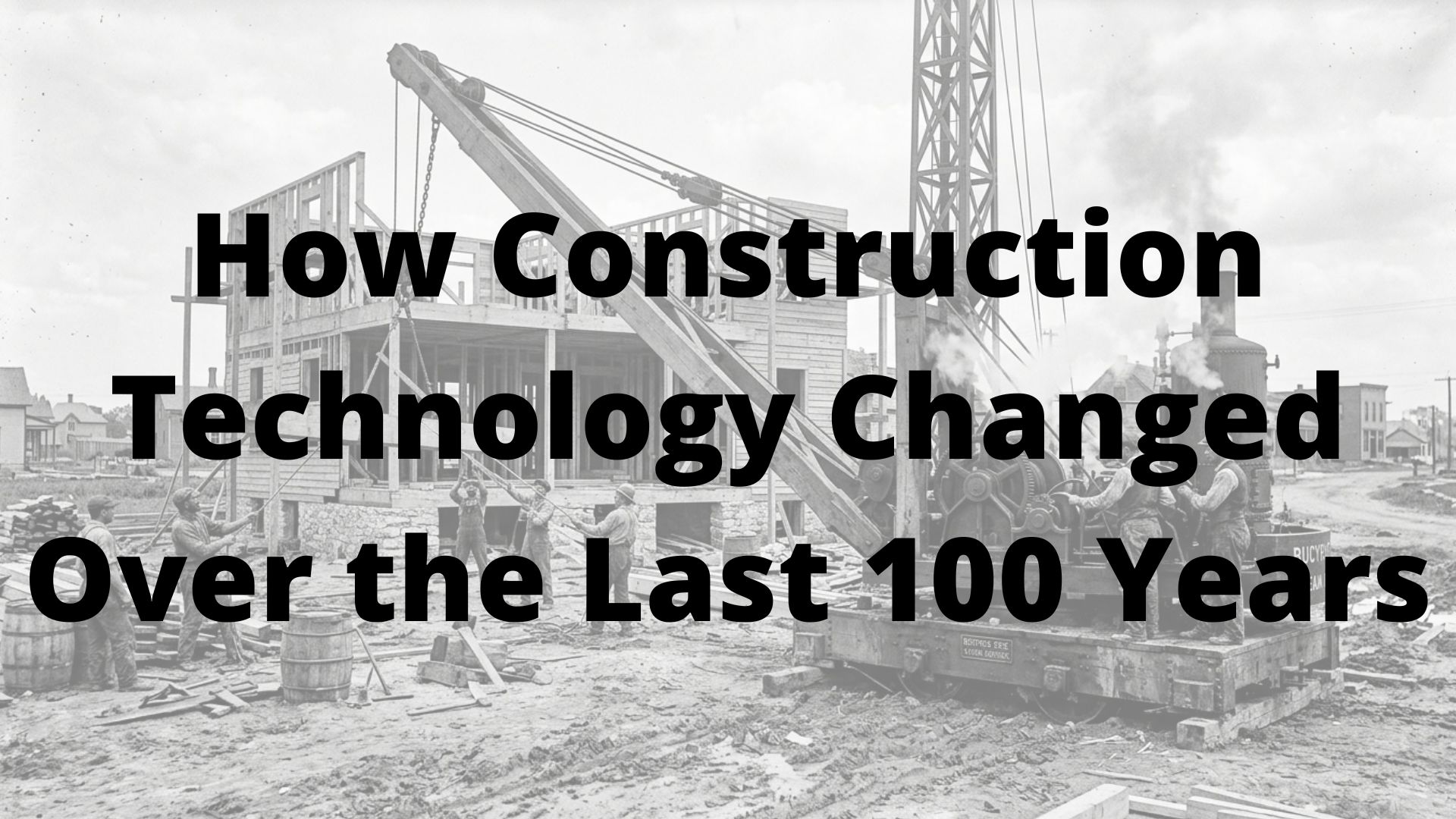
A century ago, stepping onto a construction site meant entering an environment defined by heavy manual labor, steam-powered equipment, and paper blueprints spread across wooden worktables. Building large structures required massive workforces, dangerous trial-and-error assembly, and weeks of manual engineering calculations.
Today, modern job sites look radically different. Drones survey terrain from above, 3D printers layer concrete walls in hours, and virtual reality allows project teams to walk through buildings long before ground is ever broken. Over the past 100 years, construction technology has undergone a profound evolution, transitioning from basic mechanical power to digital precision, automated systems, and advanced material science.
The mid-20th century marked a critical shift from basic mechanization to industrialized execution. The transition from steam power to the internal combustion engine brought high-capacity hydraulic excavators, bulldozers, and mobile cranes to job sites worldwide. Tasks that previously required weeks of manual labor were reduced to days, drastically accelerating the pace of urban development.
Concurrently, prefabrication and modular construction reshaped how buildings were assembled. Rather than constructing every element on-site while exposed to unpredictable weather, manufacturers began producing structural components off-site in controlled environments. This approach improved quality control, significantly reduced material waste, and streamlined on-site assembly into a faster, safer process.
The late 20th century introduced the digital tools that transformed construction planning. The adoption of Computer-Aided Design (CAD) replaced physical drafting boards with precise 2D digital layouts. However, the true digital breakthrough arrived with Building Information Modeling (BIM).
BIM shifted the industry from flat drawings to fully interactive 3D digital representations that incorporate structural, mechanical, electrical, and plumbing data. This centralized digital environment allowed architects, structural engineers, and contractors to identify design conflicts—such as a pipe routing through a structural beam—long before physical construction began. The result was a dramatic decrease in costly rework and project delays. Today, BIM has evolved into “Digital Twins,” where real-time sensor data is fed into a virtual building model to monitor structural health and operational performance throughout the facility’s lifecycle.
Alongside digital advances, civil engineering has seen remarkable material innovations over the past century. Traditional concrete and basic structural steel have given way to high-performance alternatives designed for superior durability and lower environmental impact:
- Ultra-High-Performance Concrete (UHPC): Provides exceptional compressive strength and durability, allowing for thinner, lighter structural elements.
- Cross-Laminated Timber (CLT): Engineered multi-layer wood panels capable of matching the structural integrity of steel while sequestering carbon and reducing overall build weight.
- Self-Healing Materials: Concretes embedded with specific bacteria or microcapsules that automatically react and seal cracks upon contact with air and moisture, extending structural longevity.
In recent decades, automation has transformed physical construction operations on site. Robotics and automated systems address chronic labor shortages while improving accuracy and worker safety:
- 3D Concrete Printing: Automated gantries and robotic arms extrude cementitious mixtures layer-by-layer, creating complex architectural structures in days with minimal manual labor.
- Autonomous Earthmoving: GPS and LiDAR-guided bulldozers, graders, and excavators perform site preparation and earthwork with sub-inch accuracy directly from digital design files.
- Drones and IoT Sensing: Unmanned aerial vehicles regularly survey large sites to track progress and update volumetric data, while Internet of Things (IoT) sensors embedded in concrete monitor curing temperatures and strength in real time.
The construction industry’s trajectory over the last century is a story of expanding limits. Projects that once required thousands of workers taking on significant physical risk can now be designed virtually, prefabricated off-site, and assembled using robotic tools and automated equipment. As the built environment faces ongoing challenges around urbanization, sustainability, and efficiency, the foundation established over the past 100 years ensures that construction technology will continue driving smarter, safer, and cleaner development.

John Caravella, Esq
John Caravella Esq., is a construction attorney and formerly practicing project architect at The Law Office of John Caravella, P.C., representing architects, engineers, contractors, subcontractors, and owners in all phases of contract preparation, litigation, and arbitration across New York and Florida. He also serves as an arbitrator to the American Arbitration Association Construction Industry Panel.
The information provided on this website does not, and is not intended to, constitute legal advice; instead, all information, content, and materials available on this site are for general informational purposes only. Readers of this website should contact their attorney to obtain advice with respect to any particular legal matter. No reader, user, or browser of this site should act or refrain from acting on the basis of information on this site without first seeking legal advice from counsel in the relevant jurisdiction. Only your individual attorney can provide assurances that the information contained herein – and your interpretation of it – is applicable or appropriate to your particular situation. Use of, and access to, this website or any of the links or resources contained within the site do not create an attorney-client relationship between the reader, user, or browser and website authors, contributors, contributing law firms, or committee members and their respective employers.
Resources:
- Associated General Contractors of America (AGC): Historical reports on the evolution of heavy equipment, mechanization, and modern site safety standards.
- McKinsey & Company: Research on capital projects and the digital transformation of engineering and construction.
- National Institute of Building Sciences (NIBS): Strategic frameworks and documentation on Building Information Modeling (BIM) and digital twin standards.
- American Society of Civil Engineers (ASCE): Publications on centennial advancements in structural mechanics, materials science, and civil infrastructure.