
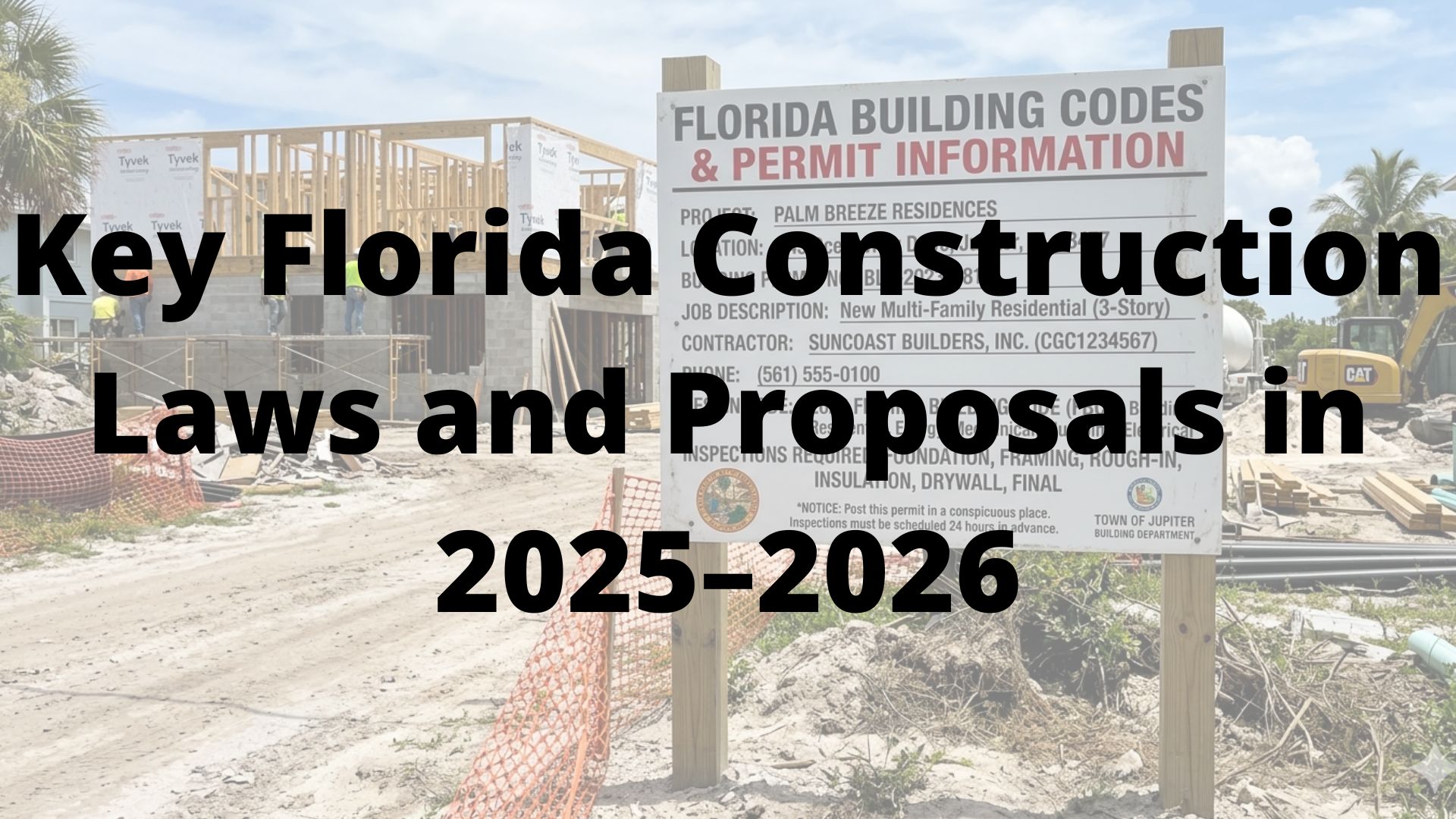
Florida continues to experience rapid population growth and large-scale development, particularly in coastal regions and major metropolitan areas. In response, the Florida Legislature has introduced and passed several bills aimed at improving construction standards, streamlining permitting, and regulating new types of development. For developers, contractors, and construction attorneys, staying informed about these legislative changes is critical to managing risk and ensuring compliance.
Below are several of the most significant construction-related laws and legislative proposals currently moving through the Florida Legislature or recently enacted.
Proposed Florida Building Code Construction Requirements (HB 911)
One notable proposal is House Bill 911, which would require stronger construction standards in future editions of the Florida Building Code. The bill directs the Florida Building Commission to mandate that certain buildings meet enhanced material and impact-resistance standards, particularly in areas vulnerable to hurricanes and severe weather.
The proposal focuses on structures such as multi-story residential buildings, residential structures located within five miles of tidal waters, emergency shelters, buildings in high-velocity hurricane zones, and reconstructed structures following natural disasters.
If enacted, the bill would significantly influence how developers design and construct residential projects in coastal regions. Stronger impact-resistant materials and wind-resistant structural elements would likely become mandatory in many new developments. The proposed effective date is July 1, 2026.
Commercial Construction Projects Reform (SB 526 / HB 405)
Another major legislative effort focuses on commercial construction permitting and contract practices.
Proposed legislation such as Senate Bill 526 and House Bill 405 seeks to streamline permitting procedures and regulate certain contract provisions in public construction projects.
Key components of these bills include establishing a uniform statewide commercial building permit application, requiring local building departments to accept standardized permit forms, limiting permit fees to the actual and reasonable costs incurred by the reviewing agency, preventing local governments from enforcing certain restrictive contract provisions in public construction projects, and requiring local jurisdictions to publish permitting information online.
Supporters argue that these measures could reduce delays in construction approvals and create greater consistency across Florida jurisdictions. Builders often face differing application procedures and fee structures from county to county, which can slow development timelines.
Construction Contract Change Order Processing (HB 683 – Effective 2025)
Florida also recently enacted legislation affecting public construction contracts.
A 2025 law now requires the prompt processing of change orders requested by local governments on public works projects. This change was implemented through Chapter 2025-140 and modifies Florida’s Local Government Prompt Payment Act.
Under the updated law, local governments must process change orders within specific timeframes, the statute establishes a clearer dispute process when payment issues arise, and contractors receive greater protection against delays caused by administrative processing.
For contractors performing government work, the law provides improved payment predictability and helps prevent project slowdowns tied to delayed change order approvals.
Continuing Changes to Florida’s Building Inspection and Permit Laws
Several additional recent laws are influencing Florida construction practice, particularly regarding inspections and permitting.
Recent reforms to Florida’s building permit statute now require local governments to approve or deny certain permit applications within defined timelines, including 30 business days for single-family residential permits under 7,500 square feet and 60 business days for many commercial or multifamily permits.
These deadlines were implemented to address widespread complaints from builders about permit backlogs and inconsistent municipal review processes.
Florida’s construction law landscape continues to evolve as lawmakers attempt to balance rapid development with safety, environmental concerns, and administrative efficiency. Proposed legislation currently under consideration could significantly affect building codes, commercial construction contracts, permitting systems, and emerging sectors such as data center development.
For developers, contractors, and construction professionals working in Florida, monitoring these legislative changes is essential. Many of these bills—particularly those involving building code standards and permitting procedures—could reshape how projects are designed, approved, and constructed across the state.

John Caravella, Esq
John Caravella Esq., is a construction attorney and formerly practicing project architect at The Law Office of John Caravella, P.C., representing architects, engineers, contractors, subcontractors, and owners in all phases of contract preparation, litigation, and arbitration across New York and Florida. He also serves as an arbitrator to the American Arbitration Association Construction Industry Panel. Mr. Caravella can be reached by email: [email protected] or (631) 608-1346.
The information provided on this website does not, and is not intended to, constitute legal advice; instead, all information, content, and materials available on this site are for general informational purposes only. Readers of this website should contact their attorney to obtain advice with respect to any particular legal matter. No reader, user, or browser of this site should act or refrain from acting on the basis of information on this site without first seeking legal advice from counsel in the relevant jurisdiction. Only your individual attorney can provide assurances that the information contained herein – and your interpretation of it – is applicable or appropriate to your particular situation. Use of, and access to, this website or any of the links or resources contained within the site do not create an attorney-client relationship between the reader, user, or browser and website authors, contributors, contributing law firms, or committee members and their respective employers.
References
Florida Legislature – HB 911: Florida Building Code Construction Requirements
BillTrack50 – HB 911 Summary
Florida Senate – SB 526: Commercial Construction Projects
Florida Senate – HB 405 Commercial Construction Projects
FastDemocracy – HB 405 Bill Analysis
Associated Industries of Florida Legislative Update
Holland & Knight – Proposed Florida Data Center Legislation
Carlton Fields – Construction Change Order Processing Law (HB 683)
Rimkus – Florida Building Code and Permit Processing Updates